PRACTICE OPERATIONS
AIGAUR HEALTHCARE PRODUCTS
Healthcare AI products built around real operational work.
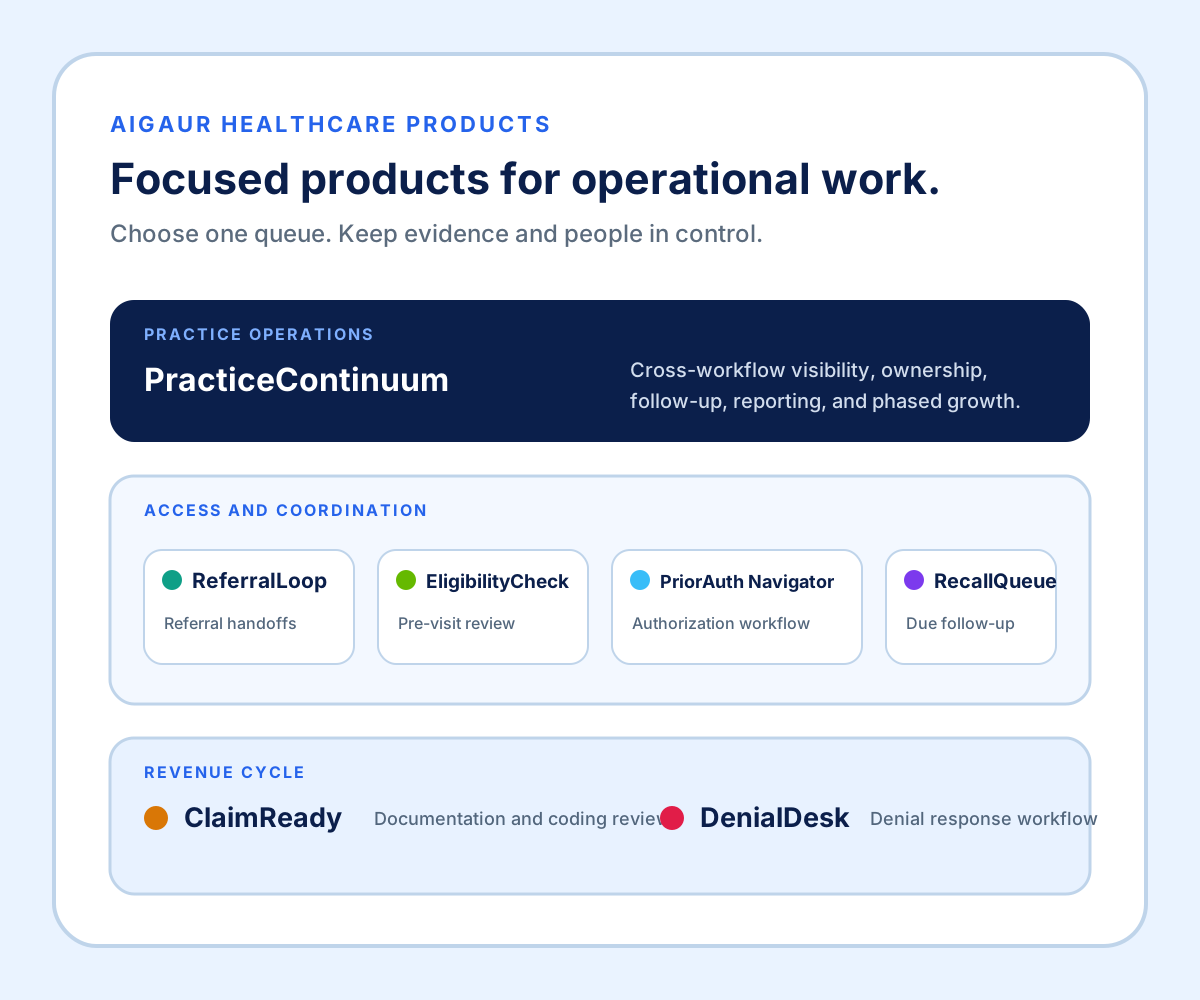
Explore focused product concepts for practice operations, referral coordination, eligibility review, prior authorization, recall follow-up, medical billing and coding review, and denial workflows. Each product organizes evidence and work while keeping qualified people responsible for decisions.
All products on this page are private concepts. Production availability, integrations, pricing, and support are defined through an approved engagement.
DIRECT ANSWER
What does AIGaur provide for healthcare operations?
AIGaur designs focused AI applications and workflow products for the administrative work around care.
The products help teams organize evidence, assign ownership, find missing information, manage exceptions, prepare review work, and preserve a decision trail. They are designed to support healthcare staff, not replace professional judgment.
FIND YOUR STARTING POINT
Choose the operating layer that matches the problem.
Start with the smallest product boundary that can improve a recurring queue and produce evidence your team understands.
ACCESS AND COORDINATION
Improve one queue before the patient or service moves forward.
Choose a focused workflow for referrals, eligibility verification, authorization preparation, or approved recall follow-up.Explore four coordination productsREVENUE CYCLE
Prepare better review work before or after a claim decision.
Use ClaimReady for documentation and coding review, or DenialDesk for adverse payer responses and response preparation.Compare revenue-cycle productsPRODUCT CATALOG
Seven products. Each with one clear operational job.
Select a product to review its workflow, intended benefits, pilot scope, measures, operating controls, and frequently asked questions.
PRACTICE OPERATIONS
Connect work across the practice journey.
Use a broad operating layer when inquiry response, follow-up, scheduling support, reporting, and staff handoffs need shared visibility.
Practice operations
PracticeContinuum
Connect the operational journey around patient access and continued engagement.Give practice leaders one operating view for inquiries, response times, follow-ups, handoffs, scheduling support, reporting, and phased growth workflows.
- Designed for
- Practice leaders and operations teams
- First pilot
- One Foundation workflow or operational queue
ACCESS AND COORDINATION
Keep pre-visit and continued follow-up work moving.
Choose a focused queue for referral handoffs, eligibility responses, authorization preparation, or organization-approved recall work.
Access and coordination
ReferralLoop
Keep referral ownership, routing, and closure visible.Organize incoming information, completeness review, routing, scheduling progress, follow-up, and final disposition for inbound or outbound referral work.
- Designed for
- Referral coordinators and scheduling teams
- First pilot
- One referral direction, service line, or location
Access and coordination
EligibilityCheck
Organize eligibility verification before the visit.Bring the verification request, returned fields, missing or conflicting details, ownership, and review timestamp into one controlled queue.
- Designed for
- Front-office and billing teams
- First pilot
- One visit type, location, or eligibility queue
Access and coordination
PriorAuth Navigator
Prepare authorization work with evidence and clear ownership.Organize requirements, supporting records, missing items, deadlines, follow-up, authorized review, and final disposition around one request workflow.
- Designed for
- Authorization and clinical administrative teams
- First pilot
- One service line, request type, or payer workflow
Access and coordination
RecallQueue
Turn approved recall criteria into visible follow-up work.Organize candidates, due reasons, ownership, outreach status, scheduling progress, exceptions, and documented dispositions.
- Designed for
- Care coordinators and follow-up teams
- First pilot
- One recall protocol or follow-up cohort
REVENUE CYCLE
Prepare review work before and after claim decisions.
Help billing and coding teams find evidence before a claim moves forward, then organize adverse payer responses when work returns.
Revenue cycle
ClaimReady
Prepare documentation and coding evidence for qualified review.Organize source documentation, surface gaps, link review questions to supporting evidence, and prepare a structured work item for an authorized biller or coder.
- Designed for
- Billing, coding, and documentation teams
- First pilot
- One document type, service line, or review queue
Revenue cycle
DenialDesk
Give every denial a reason, owner, deadline, and next action.Bring adverse payer responses, supporting records, deadlines, open questions, response preparation, and repeated cause analysis into one work queue.
- Designed for
- Revenue-cycle and appeals teams
- First pilot
- One denial category, payer workflow, or queue
SIDE-BY-SIDE COMPARISON
Compare workflow stage, team, work item, pilot scope, and capability focus.
Use the full comparison when two products appear relevant or when leaders need one view of the complete suite.
Open the product comparisonCONNECTED HEALTHCARE CAPABILITIES
Continue from product discovery to a responsible implementation path.
These pages explain the broader healthcare approach, a working synthetic prototype, engineering capabilities, operating controls, and how a bounded engagement begins.
Healthcare AI solutionsExplore the operating context, controls, official references, and use cases.Medical Coding AI WorkspaceReview a working synthetic prototype for evidence-linked coding suggestions.Enterprise AI agentsUnderstand agent tools, permissions, evidence, evaluation, and escalation.AI workflow automationConnect approved systems, rules, queues, alerts, and human review.Data and AI foundationsPrepare governed data flows, retrieval, evaluation, and reporting.Enterprise AI operationsPlan monitoring, quality review, access, release control, and incident response.Healthcare operations insightRead how teams can prepare for electronic prior-authorization workflows.Engagement and pilot scopeSee how AI Gaur approaches discovery, pilots, implementation, and ongoing operation.
BUILD WITH AI GAUR
Start with one healthcare workflow your team can evaluate.
Tell us which queue is difficult to see, assign, review, or close. We can map the current process and define a bounded product pilot.
Discuss a healthcare product Do not send patient records or protected health information through the public contact form.Questions worth asking.
What healthcare products is AIGaur developing?
AIGaur is developing seven healthcare product concepts: PracticeContinuum, ReferralLoop, EligibilityCheck, PriorAuth Navigator, RecallQueue, ClaimReady, and DenialDesk. Each focuses on a defined administrative or revenue-cycle workflow with human review.
Can an organization start with only one healthcare product?
Yes. The recommended approach is to select one recurring queue with a clear owner and measurable burden, then define a bounded pilot. The organization can evaluate operating evidence before considering another product or broader integration.
Can AIGaur healthcare products connect with an EHR, practice-management system, clearinghouse, or payer service?
Potentially. Integration depends on suitable access, contracts, permissions, data handling requirements, code-set licensing, secure architecture, and testing. Connections are separately scoped and begin read-only wherever practical.
Do these products replace clinicians, coders, billers, or healthcare staff?
No. The products organize evidence, work status, ownership, exceptions, and review. Qualified clinicians, coders, billers, and authorized staff remain responsible for professional interpretation, communication, and final decisions.
Can patient information be submitted on the public AIGaur website?
No. Do not send patient records, protected health information, member identifiers, credentials, payer files, or confidential documents through public forms. Secure data handling is designed separately for an approved engagement.