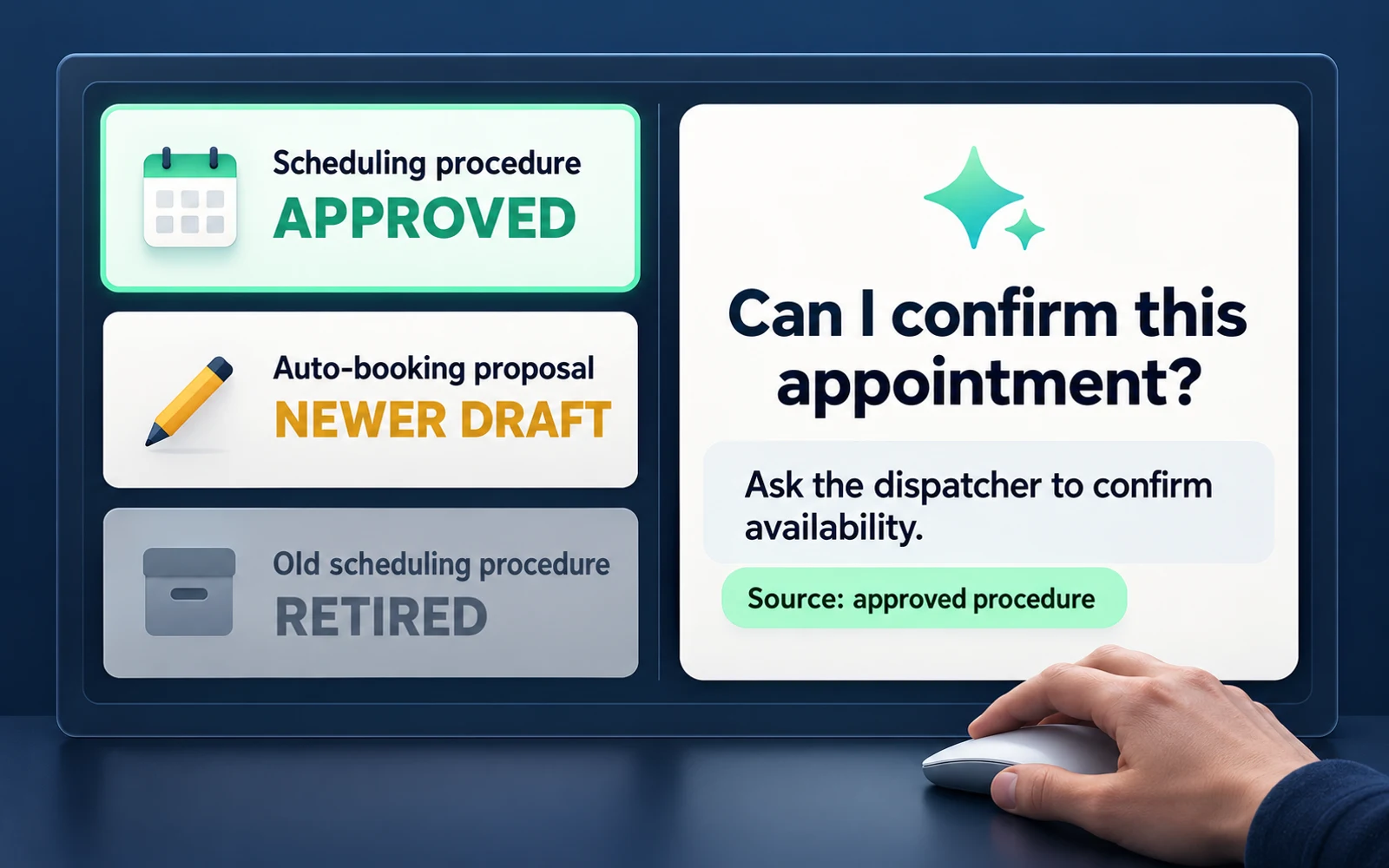
A newer file may still be a draft
Consider a synthetic example from a service business. The approved appointment procedure says a dispatcher must confirm availability before a customer is offered a visit. A newer planning document describes a proposed self-booking process that has not been approved.
An assistant finds both documents. Choosing the newer file could turn a proposal into a customer-facing promise. Combining them could produce an instruction that neither document author intended.
The process owner should establish which procedure is in force and for which work. The assistant’s role is to follow that documented decision and identify gaps. A file’s modification date alone does not establish approval or applicability.
Record why a source is allowed to answer
Before connecting a collection, create a small source register. For each procedure, record:
Source register: The process it covers and the role responsible for it; Its approval status and the person authorized to change that status; Its effective date, version and any procedure it replaces; The teams, locations or service types to which it applies; Where the authoritative copy lives and who can access it.
This is a proposed operating checklist, not a checklist prescribed by a regulator. NIST’s AI RMF Govern Playbook calls for clear, documented responsibilities and communication. A named procedure owner makes that principle concrete in a knowledge workflow.
If the team cannot explain a source’s status, keep it out of the answer set until the owner resolves the question. For a broader implementation, AI agents using business knowledge need these source rules alongside permissions and tool boundaries.
Define precedence for the actual question
Avoid one broad instruction such as “always use the latest document.” A current procedure may apply to one service while an older, still-approved procedure applies to another.
Ask the process owner what information determines the applicable rule. It might be the service type, the team handling the work or the date an instruction takes effect. If the assistant lacks a necessary detail, it should ask for that detail or refer the question for review.
For the appointment example, a useful result would identify the approved dispatcher procedure and its scope. If the source register lists both instructions as approved for the same situation, the owner needs to resolve that inconsistency. The assistant should not decide which approval was intended.
Retire the retrieved copies too
Removing an old document from a shared folder may be only one part of a source update. Depending on the implementation, the assistant may use extracted passages, a search index, cached results or previously saved answer material.
Define how a retired source is excluded from each place used to prepare an answer. Keep a connection between retrieved passages and their source version so a reviewer can investigate an outdated result. Where retention is required, distinguish an archived record from a source eligible for current answers.
NIST’s Generative AI Profile recommends reviewing sources and citations in generated outputs and verifying relevant data provenance. The retirement process described here is our proposed implementation approach. A citation helps a reviewer inspect a source; it does not, by itself, establish that the source is authoritative.
Test the change, including the questions that should stop
Use synthetic questions before connecting customer records or enabling replies. Include an approved procedure, a newer draft, a retired version and a case with missing scope information. Have the process owner write the expected source and action before reviewing the assistant’s output.
Then retire one source and repeat the relevant questions. Check the retrieved passages as well as the final answer. A fluent response should not hide a reference to material that should no longer be used.
Record wrong-source selections, missed conflicts, unnecessary referrals and the effort needed to investigate them. Agree stop conditions with the owner before expanding use. NIST cautions against extrapolating performance from narrow assessments, so a small test set does not establish reliability for every procedure or user.
These tests complement, rather than replace, the human approval boundaries for AI agents. An approved source does not automatically authorize an assistant to change records, confirm appointments or send messages.
Start with one procedure the team can own
Choose one recurring question and the documents currently used to answer it. Establish the source owner, approval status, scope, retirement process and escalation route. Use fixed rules where they are sufficient; adding an AI assistant is useful only if the task warrants it. NIST’s AI RMF Map Playbook recommends documenting the intended task and considering non-AI alternatives.
AI Gaur can help scope a bounded knowledge-readiness assessment and evaluation. Bring one workflow and a description with confidential details removed to discuss the source and review requirements. Any implementation or ongoing AI operations work should have agreed deliverables, acceptance criteria, access, monitoring and support responsibilities. Accuracy and time savings depend on the workflow, source quality and operating controls.
Sources checked 29 October 2026. NIST’s resources are voluntary risk-management guidance, not a compliance certification. The Playbook currently notes that AI RMF 1.0 is being updated.
Sources
- NIST AI RMF Playbook: Govern 2.1
- NIST Generative AI Profile: source review, provenance and evaluation
- NIST AI RMF Playbook: Map 1.1
Written by AIGaur, a product and technology company in Edison, New Jersey. About the company.
Discuss a related project