01
Menu and channel consistency
Maintain approved menu, hours, location, and service information and flag differences across the website, ordering, maps, and campaigns.
AI GAUR / RESTAURANT OPERATIONS
AI Gaur helps restaurants keep menus and hours current, coordinate reservations and private events, prepare guest responses, monitor operating exceptions, and connect daily reporting. Staff remain responsible for food safety, allergen guidance, hospitality, and operational decisions.
Discuss a restaurant workflow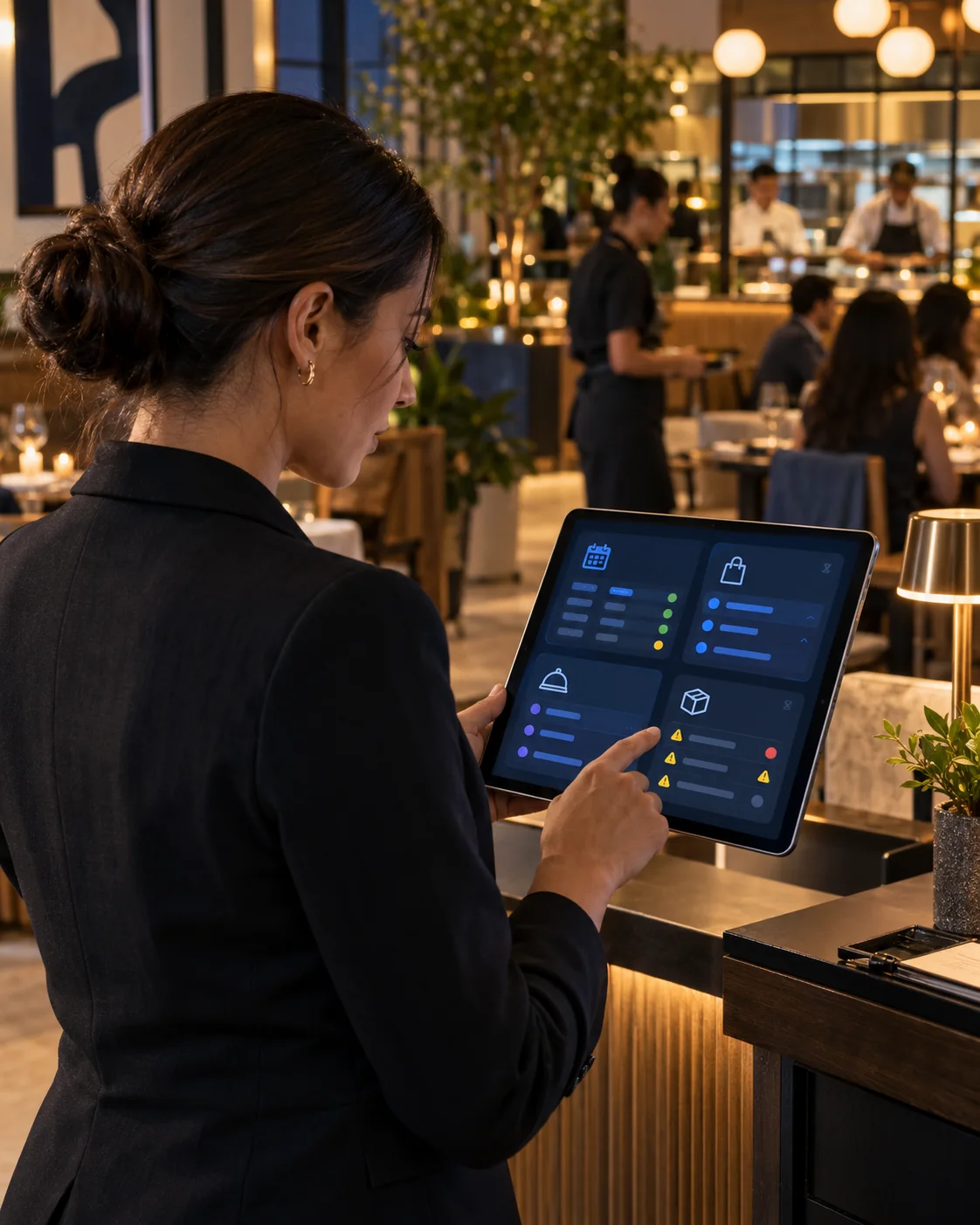
DIRECT ANSWER
AI Gaur builds systems for menu information, reservation and event inquiries, guest messaging, order exceptions, review-response preparation, inventory alerts, and daily operating reports.
The system should use the current menu, hours, capacity, and policies. It can prepare and route work, but staff must confirm availability, allergen information, food-safety decisions, refunds, and any promise made to a guest.
SERVICE-EXCEPTION WORKSPACE
A restaurant receives requests through several channels. The workflow can identify the request, retrieve current information, propose an approved response, and route any capacity, order, allergen, or policy exception to the right staff member.
Collect the channel, location, party or order details, timing, and requested service.
Check approved hours, menu data, capacity, order status, and current operating policies.
Suggest the next administrative action or approved response and identify missing details.
Send capacity conflicts, allergen questions, refunds, complaints, and unusual requests to staff.
Confirm only the approved action, record the outcome, and keep reporting data current.
WHERE AI CAN HELP
Each use case is shaped around the restaurant’s locations, reservation and ordering platforms, menu ownership, staffing, service standards, and safety responsibilities.
Maintain approved menu, hours, location, and service information and flag differences across the website, ordering, maps, and campaigns.
Capture booking, catering, and private-event requests, check administrative completeness, and assign exceptions to staff.
Answer from approved hours, directions, menu, reservation, and policy data while routing availability and special requests.
Group delayed, incomplete, duplicate, or disputed orders and show the responsible location or platform owner.
Classify feedback, prepare a factual draft in the restaurant’s tone, and require review before sensitive responses are published.
Combine approved sales, purchasing, and stock signals to surface unusual variance or items that need a manager’s attention.
GUEST-SERVICE WORKFLOW
The system must not promise a table, confirm an order change, or provide an allergen assurance unless the authoritative system and responsible team support that action.
Capture the request, location, channel, timing, and relevant reservation or order identifier.
Retrieve current menu, hours, capacity, status, and approved policy information.
Offer the allowed next step or draft a response using approved language.
Move safety, allergen, capacity, refund, complaint, and low-confidence cases to staff.
Release only the approved result and record the outcome for service and reporting.
Illustrative workflow. Exact steps depend on the organization, location, systems, contracts, professional duties, and applicable requirements.
SERVICE AND OPERATIONS
A useful pilot measures whether the restaurant answers current questions faster, completes more qualified requests, and gives managers a clearer view of exceptions.
Use an approved source for menus, hours, locations, and policies, then flag mismatches before guests find them.
Handle routine administrative checks while moving special requests and service recovery to the people responsible.
Group common questions, booking issues, order exceptions, and feedback themes so managers can improve the underlying process.
OPERATING CONTROLS
The restaurant and its advisers determine applicable food-safety, allergen, labeling, accessibility, privacy, payment, employment, and local requirements. AI Gaur implements the agreed workflow controls.
Connect answers to approved menu, hour, capacity, location, order, and policy sources with timestamps.
Keep food safety, allergen guidance, refunds, service recovery, staffing, and operational decisions with responsible people.
Never infer that a dish is safe for a guest from a model’s general knowledge or an incomplete ingredient list.
Separate reservation and order messages from promotional communication and respect opt-outs.
Limit guest, employee, order, and payment-related data to what the workflow needs and retain it only as approved.
Escalate missing, conflicting, urgent, safety-related, and low-confidence requests without making a promise.
A PRACTICAL ENGAGEMENT
Document channels, systems, peak periods, owners, safety boundaries, exceptions, and baseline response.
Choose one request type and define approved facts, allowed actions, escalation, and acceptance criteria.
Test routine and difficult examples, including capacity conflicts, menu changes, allergens, and complaints.
Connect approved systems, monitor accuracy and service outcomes, control changes, and expand carefully.
No. Accurate menus, hours, reservation paths, and staff ownership may solve the immediate problem. Add an assistant only when it can use current information and escalate uncertainty.
Only when the approved reservation system supports the action and returns a confirmed result. Otherwise it should collect the request and clearly state that staff confirmation is still required.
It can retrieve approved ingredient and allergen information for staff or display a clearly maintained source. It should not infer safety, account for cross-contact on its own, or replace a conversation with responsible restaurant staff.
Possibly. We verify APIs, permissions, data ownership, rate limits, location setup, and the system that remains authoritative before designing the workflow.
It may help surface sales, purchasing, and inventory patterns for a manager to review. Savings depend on data quality, forecasting conditions, menu operations, purchasing, and staff use, so a measured pilot is required.
Start with menu and hours consistency, reservation inquiry routing, or private-event intake. These have clear sources, measurable delays, and a human owner.
OFFICIAL OPERATING REFERENCES
Requirements and professional guidance change. The system should preserve source ownership and effective dates instead of treating a model’s memory as policy.
Build assistants with approved sources, clear permissions, and defined escalation.
Explore Enterprise AI AgentsConnect systems, work queues, notifications, and human approvals.
Explore AI Automation & n8nPrepare governed data flows, retrieval, evaluation, and operational reporting.
Explore Data + AIMonitor quality, access, cost, incidents, and controlled releases.
Explore Enterprise AI OperationsBUILD WITH AI GAUR
Show us the repetitive work, disconnected tools, or slow decision. We’ll help define a useful AI system and the controls it needs.
Discuss your workflow